





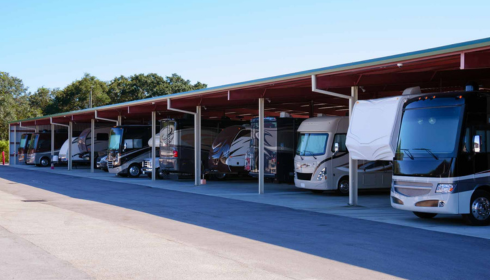
Parking an RV in a storage property sounds simple until the first tight corner, low clearance bar, or narrow lane makes entry a challenge. Size limits aren’t just numbers on a spec sheet—they determine whether a vehicle fits safely every time, without scraping, blocking traffic, or creating preventable stress. Before choosing RV storage units, the most overlooked details are often the deal-breakers.
Measuring Total RV Height Including Antennas and Roof Accessories
Total height isn’t measured at the roofline. Air conditioners, Wi-Fi domes, solar mounts, rooftop racks, and antennas often raise the highest point another 8–14 inches. Many owners measure the base RV height and forget the add-ons, only to find out later that a clearance bar or indoor ceiling tells a different story.
Height also changes slightly when suspension settles after loading, filling tanks, or adding gear. Storage properties near highways may include covered parking, lighting fixtures, or security beams that sit lower than expected. Knowing the true highest point—not the listed model height—prevents avoidable damage.
Confirming Entry Clearance at Gates, Canopies, and Door Frames
The entrance is the first test. Keypad gates, canopy roofs, security camera mounts, and aluminum cross-bars above access points may limit vertical space more than the storage aisle itself does. A property can advertise tall parking but still have a shorter pinch point at the entry. Drive path clearance matters just as much as parking clearance. Vehicles that clear the stall might still clip a gate frame, light assembly, or canopy edge before reaching it. The safest approach is verifying the lowest obstruction from street to storage space, not just at the destination.
Allowing Extra Width for Mirrors, Awnings, and Slide-out Housings
Actual RV width always exceeds the listed body width. Mirrors extend far beyond the chassis, and awning hardware adds inches on one or both sides. Slide-out frames also protrude even when retracted, meaning the widest part of the vehicle is rarely the walls. Side clearance impacts more than whether the RV “fits.” It determines mirror safety when passing posts, the ability to walk beside the unit without squeezing, and avoiding side contact with bollards or fences. Storage shoppers who search for storage units near me often forget to mentally add unpredictable width—wind sway, minor steering corrections, and entry angles all widen the space needed.
Checking Lane Spacing for Safe Two-way Movement Inside the Property
Drive aisles must accommodate passing room, not just single-vehicle fit. Facilities that support Class A motorhomes and large tow rigs should offer wide lanes that allow two large vehicles to move without one pulling aside or stopping.
The real test isn’t a static measurement—it’s movement. An RV rarely travels perfectly centered. A slightly late steering adjustment or passing another driver at a slow roll can shift the needed clearance by a foot or more in seconds. Lanes designed too tightly feel manageable at first, but become problematic during busy hours or when backing into a space.
Understanding Pavement Turning Allowances for Longer Wheelbases
Long wheelbase RVs, fifth-wheels, and tow combinations track differently than passenger vehicles. The rear wheels follow a tighter path than the front, cutting sharply inward on turns. This is why long rigs can clear an intersection but still climb a curb or clip a corner inside a facility. Turn design is more than curve width. Pavement should accommodate real turning behavior without forcing drivers to swing wide into oncoming lanes or mount curbs. Storage properties built with large vehicle circulation in mind factor this into their layout, reducing chances of trailer hop or tire drag during tight turns.
Spotting Corner Curvature Limits That Impact Backing into a Space
Backing an RV into a stall is controlled geometry. A turn that’s slightly too sharp reduces the entry angle and forces mid-maneuver corrections. Multiple correction moves aren’t just inconvenient—they raise the risk of sidewall scuffs, rear bumper alignment issues, or jackknife stress on tow hitches.
Corners with square 90-degree edges are the hardest to work with, especially for long rigs. Softer, curved corner paths give drivers a smoother arc to line up their approach in fewer moves. The difference between a curved and squared turn can mean backing straight in versus rebuilding the entire angle three or four times.
Verifying Stall Width for Side Door Access Without Obstructions
A stall that “fits” isn’t always a stall that functions. RV living spaces are accessed through side doors, often the same side closest to the stall divider, fence, or adjacent vehicle. If the unit fits but the door can’t open fully, the space becomes partially unusable. Functionality also applies to safety. Emergency exits, cargo bays, and external storage compartments should be reachable without climbing over site markers or squeezing against posts. The ideal space doesn’t just store the RV—it allows normal access while parked.
Calculating Real-world Maneuver Room, Not Just Listed Measurements
Dimension listings don’t capture real maneuver space. A 40-foot RV doesn’t operate in a perfect 40-foot envelope. Steering sweep, rear swing, mirror radius, bumper overhang, and gradual turning arcs extend the functional footprint well beyond the printed length and width.
Real maneuver planning accounts for entry approach, turning arc, reverse alignment, exit path, and the presence of other vehicles. Drivers who test these factors ahead of time avoid tight surprises that measurements alone fail to predict. Fit matters, but movement matters more.
Storage properties that support larger rigs need to balance height clearance, wide lanes, smooth turning paths, safe stall access, and practical maneuvering space. Drivers looking for RV storage units that accommodate real vehicle behavior—not just static dimensions—can find spaces designed for proper fit, entry, and everyday use. Facilities like Storage Partner deliver layouts intentionally built for large-vehicle access, turning tolerance, and driver confidence.
 Admin
Admin